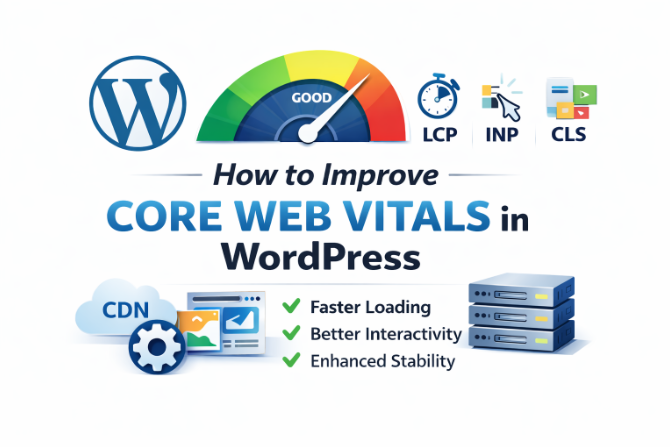
Fast website speed and good user experience is not a choice anymore because this impacts SERP, conversions, and engagement. With the rollout of Core Web Vitals WordPress, performance optimization is now a major part of technical SEO. WordPress Foundation gives you some pretty powerful tools and flexibility to deliver better performance, but you need the right approach to do so.
Optimizing core web vitals WordPress is a step by step process, here you will learn & improve your website performance using proven techniques, tools & methods to enhance loading, interactivity & required visual stability to your business website within no time.
Understanding Core Web Vitals
Core Web Vitals are these performance metrics which reflect the performance of page in real experience by users. Next, they must knock these three points out of the park.
1. Largest Contentful Paint (LCP)
Quantifies the load time of larger visible element (like image, banner, or heading).
Ideal score: Under 2.5 seconds.
2. Interaction to Next Paint (INP)
In 2024, it will even take the place of First Input Delay (FID). It is a fraction that assesses the time it takes for the site to respond to user interactions.
3. Cumulative Layout Shift (CLS)
This monitors the visual stability & ensures that elements do not jump around the page as it loads.
Little wonder, too, as these metrics determine where a site appears with regards to rankings, as well as user satisfaction!
Complete Guide: How to Improve Core Web Vitals WordPress
How do you improve Core Web Vitals if you host your own website? (Which 99% of copywriters should be doing) Improving Core Web Vitals takes Hosting tweaks, image compressions, caching, cleaning code up, learning how to use plugins better. Each method is then explained in depth in the following steps.
Step 1: Opt for a Good Quality WordPress Hosting
Foundation of Performance: Your Hosting Provider Slow servers also cannot be salvaged even by perfect optimization.
What to Look For:
- SSD or NVMe storage
- Latest PHP versions (PHP 8+)
- Built-in caching
- Global CDN support
- WordPress stack based on LSL or NGINX
A managed WordPress hosting platform typically provides a better Core Web Vitals score out of the box since they include automatic performance tuning.
Slow hosting mainly affects:
- LCP (slow content rendering)
- INP (server delay)
- Time to First Byte (TTFB)
Upgrading Hosting: One of the quickest solutions to learn how to optimize core web vitals WordPress.
Step 2: Use a Content Delivery Network (CDN)
A CDN distributes your site across a number of global servers, delivering content to users from the closest possible location.
Cloudflare is one of the most popular CDN providers.
Benefits:
- Faster image delivery
- Reduced server load
- Lower latency
- Improved LCP scores
CDNs are especially important for:
- International traffic
- Image-heavy websites
- eCommerce stores
Enable:
- Brotli compression
- HTTP/3
- Edge caching
These features significantly speed up loading.
Step 3: Optimize Images (Largest Performance Impact)
In general, images represent 50–80% of the overall size of a page and are therefore typically the largest propellant in slow loads.
Image Optimization Techniques:
Images into WebP or AVIF
Many modern formats compress to 30–70% of original size. Here, you can use the Oualator PNG to WEBP converter with image compression option.
Compress Images
Compress losslessly to preserve structure
Resize Images Properly
Never, ever upload images at a different size that they need to be.
Enable Lazy Loading
Images are lazy-loaded — they only go live when users scroll.
Improving LCP is one of the most important steps in learning how to improve core web vitals WordPress (Image optimization)
Step 4: Implement Caching (Critical for Speed)
Caching saves the static versions of your pages so they are served instantly instead of generating again and again yourself.
Types of Caching
Page Caching
Stores full page HTML.
Browser Caching
It saves the assets on the local browser of the user.
Object Caching
- Improves database performance.
- Performance Plugins One of the most well-known performance plugins is WP Rocket.
Recommended Settings:
- Enable page cache
- Enable cache preloading
- Activate GZIP compression
- Minify CSS & JS
Caching significantly improves:
- LCP
- INP
- Server response time
This is the basic technique for a user searching on the web – how to improve core web vitals WordPress.
Step 5: Minify and Remove Unused CSS & JavaScript
These heavy CSS and JavaScript files hinder rendering and decrease the interactivity of your web page.
Optimization Methods
- Remove unused CSS
- Defer non-critical JavaScript
- Inline critical CSS
- Load scripts conditionally
Most themes load scripts site-wide regardless of any of it being necessary.
Example:
- Loading slider scripts for pages that do not contain the slider
- Loading form scripts on all pages
Deleting unused assets can decrease the load time by 30–50%.
Step 6: Install a Lightweight WordPress Theme
The worst offenders can be poorly coded themes that are the number one cause of low Core Web Vitals scores.
Choose Themes That Are:
- Minimal in design
- Optimized for performance
- Regularly updated
- Compatible with caching plugins
Avoid:
- Multipurpose themes with excessive features
- Heavy page builders without optimization
LCP and CLS can be immediately boosted by switching to a lightweight theme.
Step 7: Optimize Fonts for Faster Rendering
Fonts often block page rendering.
Best Practices:
- Use system fonts where possible
- Limit font weights
- Preload important fonts
- Use font-display: swap
Host Google Fonts Locally (to Reduce External Requests)
The importance of font optimization is such that it can greatly influence either positively or negatively the rendering speed and because of that how to improve core web vitals wordpress.
Step 8: Reduce Plugin Usage
Too many plugins increase:
- Database queries
- JavaScript load
- CSS size
Plugin Optimization Checklist
- Delete unused plugins
- Remove heavy plugins for lightweight options
- Avoid duplicate functionality
To get more performance, switch to one plugin instead of four or more.
Step 9: Optimize the WordPress Database
Over time, databases accumulate:
- Post revisions
- Spam comments
- Transients
- Auto-drafts
A clean database keeps the server response time charged.
Database Optimization Tools
- Automatic cleanup plugins
- Hosting-level optimization tools
- Scheduled cleanup tasks
Optimizing the database has an impact on INP and all metrics of speed.
Step 10: Enable GZIP and Brotli Compression
Compression shrinks the file sizes and then sends them to users.
This is done automatically in most modern hosting providers.
File Types Compressed:
- HTML
- CSS
- JavaScript
It compresses to consume less bandwidth and it also loads faster.
Step 11: Use Performance Testing Tools
Performance testing with blazing cores helps you identify the issues affecting Core Web Vitals.
Two reliable tools include:
- GTmetrix
- Google PageSpeed Insights
These tools analyze:
- Render-blocking scripts
- Image optimization issues
- Server response time
- Layout shifts
Regular testing is crucial while you are learn how to improve core web vitals WordPress as performance can fluctuate after updates/ install and update on some plugins.
Step 12: Preload Important Resources
With preloading you specify to the browser what to load first.
Common Resources to Preload:
- Fonts
- Hero images
- Critical CSS
Prioritizing what is visible on the screen first gives a direct shot to LCP.
Step 13: Fix Layout Shift Issues (CLS Optimization)
Layout shifts are disruptive to the user experience.
Common Causes:
- Images without dimensions
- Ads loading dynamically
- Fonts swapping late
Solutions:
- Images should always have width/height specified
- Reserve ad space
- Preload fonts
Higher engagement is driven by the improvement to visual stability offered by reducing CLS.
Step 14: Update WordPress, themes, and plugins
Updates often include performance improvements.
Always update:
- WordPress core
- Themes
- Plugins
Time to upgrade: Older versions slow down load time and pose security threats.
Step 15: Use Server-Level Optimization
Advanced optimization includes:
- LiteSpeed servers
- Redis object caching
- HTTP/3 protocol
For sites with a lot of traffic, implementing these methods drastically increases performance.
Common Mistakes That Hurt Core Web Vitals
Avoid these frequent performance errors:
- Uploading uncompressed images
- Installing too many plugins
- Heavy unoptimized page builder usage
- Ignoring mobile performance
- Not using caching or CDN
Because these factors are very important to learn how to fix core web vitals wordpress.
Recommended Optimization Workflow
For better results, kindly follow the orders as it is.
- Upgrade hosting
- Install caching plugin
- Optimize images
- Enable CDN
- Remove unused scripts
- Optimize database
- Test performance
And this keeps on regularising the progression.
Final Takeaway
Optimizing for Core Web Vitals is not a one-and-done process. It is part of a larger performance strategy. Form selecting a good hosting to responsive image, script, and cache optimization makes every step of the way in the result of improving loading speed and a recommendable user experience.
Not only will these techniques give you an idea about how to enhance core web vitals wordpress, they will also help you boost your SEO rankings, conversions, and performance of the website as a whole, if done rightly.
Regular testing and updates help in optimizing your site speed and keeping it the top of the game in search results.

An experienced technical content writer with expertise in crafting insightful technology blogs. He studies emerging trends, analyzes tools before drafting, and ensures every piece reflects the latest innovations. His content blends clarity, research, and up-to-date technical understanding.